
FHA vs Conventional in Miami: Which Home Loan is Right for You?
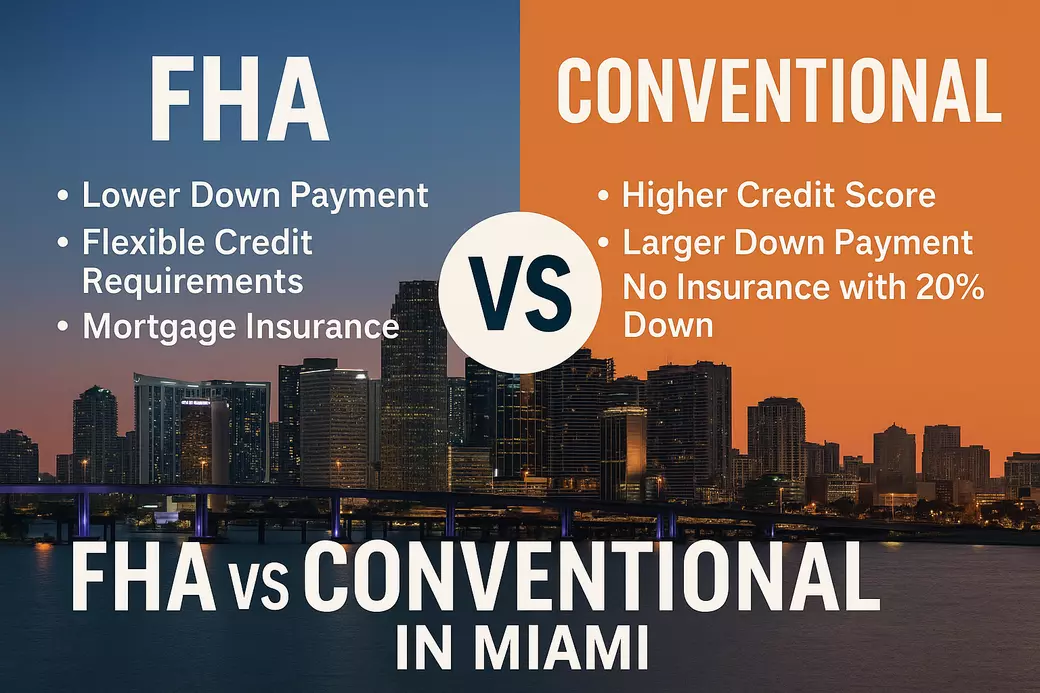
FHA vs Conventional in Miami: Which Home Loan is Right for You?
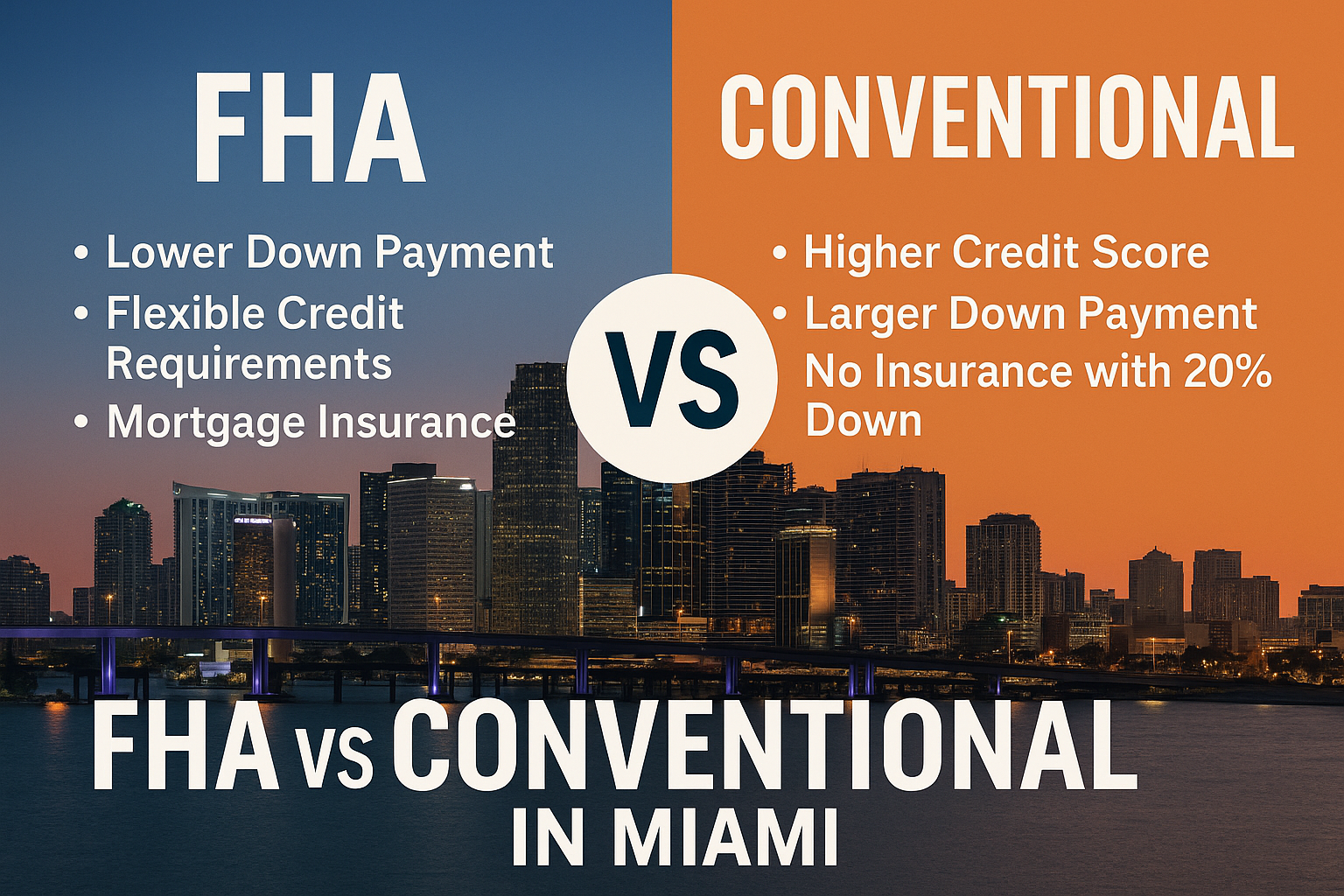
Deciding between FHA and conventional mortgages in Miami? Discover key differences in down payment, credit requirements, mortgage insurance, and which loan works best for first‑time buyers, investors, or long-term homeowners.
Introduction
When buying a home in Miami, one of the first—and most important—decisions you’ll face is: which type of mortgage loan should you use? Choosing between a FHA loan and a Conventional mortgage can significantly impact how much you pay upfront, your monthly payments, and long‑term financing flexibility. Because Miami’s real estate market comes with high home prices, insurance costs, and unique property‑type considerations, understanding the pros and cons of each loan type matters more than ever.
In this post, we’ll break down how FHA and Conventional loans differ — and help you decide which might fit your financial situation and home‑buying goals best.
What Are FHA and Conventional Loans — Basic Definitions
-
FHA loans are mortgages insured by the Federal Housing Administration (FHA). That insurance reduces lender risk, which allows lenders to offer more flexible qualification standards than many traditional loans.
-
Conventional mortgages are privately issued loans — not backed by a government agency. They follow standard underwriting criteria (credit score, debt‑to‑income ratio, etc.) and are often used when borrowers have strong credit and enough savings for a larger down payment.
Both loan types can be used for homebuying in Miami — but each works differently depending on your financial background, goals, and the property you’re buying.
Key Differences: FHA vs Conventional — Down Payment, Credit, Insurance, Flexibility
Down Payment & Credit Score Requirements
-
With an FHA loan, you may qualify with as little as 3.5% down if your credit score is 580 or higher.
-
Some FHA‑approved lenders accept lower scores (even 500–579), but that may require a higher down payment (e.g. around 10%).
-
Conventional loans typically expect a higher credit score — often 620 or above — and while some programs allow down payments as low as 3–5%, better rates and terms come with stronger credit and larger down payments.
What this means: If you have limited savings or a modest credit history, FHA can offer a more accessible path to homeownership. If you have good credit and some savings, conventional may offer long‑term savings.
Mortgage Insurance (MIP / PMI): Cost & Duration Differences
-
FHA loans require two kinds of mortgage insurance: an up‑front mortgage insurance premium (UFMIP) — typically around 1.75% of the loan amount — plus an ongoing monthly premium (MIP). These apply regardless of how much you put down.
-
For many FHA loans, the mortgage insurance stays for the life of the loan (unless you refinance or meet specific criteria, like putting 10% down).
-
Conventional loans require private mortgage insurance (PMI) only if you put down less than 20%. And once your equity reaches 20–22%, you can typically cancel PMI — reducing monthly payment significantly.
What this means: FHA offers lower upfront barriers, but often higher long‑term costs because of mandatory mortgage insurance. Conventional may require more upfront capital but could be cheaper over time if you can avoid or cancel PMI.
Flexibility & Eligibility — Who Qualifies, Who It Helps
FHA loan tends to make sense if you:
-
Have lower credit scores or a limited credit history.
-
Have smaller savings for a down payment.
-
Are a first-time buyer, steady-income worker, or someone whose finances aren’t perfect but want homeownership.
-
Might have had past financial setbacks (bankruptcy, foreclosure) — FHA’s more lenient underwriting can help.
Conventional loan tends to suit buyers who:
-
Have a good credit score and consistent income.
-
Have savings for a larger down payment or can quickly build equity.
-
Want flexibility: conventional loans often allow for investment properties or second homes (whereas FHA often limits to primary residences).
-
Prefer avoiding long-term mortgage insurance and want lower monthly payments if they can secure good down payment and equity.
What It Means Specifically for Miami — Local Considerations
Miami has unique real‑estate dynamics: higher home prices, more condominiums, and additional costs (like homeowners insurance, flood or hurricane risk, HOA fees). This context affects how useful FHA or Conventional may be for you:
-
Loan limits and home prices: Because many homes and condos in Miami are priced above average, a conventional loan (especially conforming or jumbo) may align better with expensive properties. FHA loan limits may restrict some higher‑priced homes.
-
Property type matters: For condos or HOA properties — common in Miami — FHA often has stricter appraisal and property‑condition rules. If the condo/building doesn’t meet FHA’s standards, FHA financing may be denied. Conventional loans offer greater flexibility in property types.
-
Long‑term cost of insurance: Given flood, hurricane, and coastal exposure in Miami, added homeowners and flood insurance costs can make long-term expenses higher. Conventional loan + 20% down may help mitigate insurance + mortgage insurance overlap that FHA requires.
Because of these local realities, buyers should weigh not only loan‑type criteria, but also property type, neighborhood, and insurance/resilience costs — not just price and down payment.
When FHA Makes Sense — Ideal Buyer Profiles
FHA may be well‑suited for:
-
First‑time homebuyers with limited savings or lower credit scores.
-
Buyers who want the lowest possible down payment to get into a home quickly.
-
People with stable income but recent financial setbacks — who still meet FHA’s more lenient qualification standards.
-
Buyers who plan to stay long‑term in their home and don’t mind mortgage insurance for a while.
When Conventional Makes Sense — Ideal Buyer Profiles
Conventional often works best for:
-
Buyers with good credit and savings — ready to make at least a 10–20% down payment.
-
Those looking for long-term savings: lower monthly payments once PMI is removed.
-
Buyers interested in investment properties or second homes — since conventional loans are more flexible for investment/second‑home financing.
-
Buyers concerned about long‑term mortgage insurance burden, especially in a high‑cost real‑estate market like Miami.
How to Decide — Practical Checklist for Your Situation
Before you choose between FHA and Conventional, run through this checklist:
-
Check your credit score and savings — lower credit or savings ✅ ⇒ FHA; strong credit & savings ✅ ⇒ Conventional.
-
Estimate total monthly payment — include mortgage principal + interest + mortgage insurance (MIP/PMI) + homeowners/flood insurance + HOA or condo fees (if applicable).
-
Consider property type & location — condominium, coastal, older homes — these might favor Conventional if FHA requirements are restrictive.
-
Think about how long you’ll stay in the home — short-term? Maybe conventional or avoid mortgage-insurance burden; long-term? FHA may still work.
-
Consult a local lender or real‑estate agent familiar with Miami regulations, HOA/condo standards, and insurance costs.
Conclusion — There’s No One‑Size‑Fits‑All
Deciding between FHA and Conventional mortgages when buying in Miami depends heavily on your financial situation, credit, savings, and long-term goals.
-
FHA offers accessibility: lower down payments, and more lenient requirements — great for first-time or budget-conscious buyers.
-
Conventional offers flexibility, potential long‑term savings, especially for well-prepared buyers with good credit and enough savings.
Given Miami’s unique housing market — with high home prices, many condos, insurance and HOA costs — there’s no universal “best” option. The right choice depends on you.
If you’d like personalized guidance based on your credit, down payment, and desired neighborhood — I can help you map which loan type fits best, and even run a cost comparison for a typical Miami home.
FAQ — FHA vs Conventional in Miami (Voice‑Search & SEO Friendly)
Q: What credit score is required for FHA vs Conventional loans?
A: FHA loans may accept scores as low as 580 (sometimes 500 with higher down payment); conventional loans usually require around 620+ for best rates.
Q: How much down payment is needed for each loan type?
A: FHA: around 3.5% with 580+ credit. Conventional: 3–5% for many loan programs, but 10–20% down helps avoid mortgage‑insurance or lower costs.
Q: Do I have to pay mortgage insurance with both loans?
A: Yes. FHA requires upfront + ongoing mortgage‑insurance premiums (MIP) regardless of down payment. Conventional requires PMI only if down payment is less than 20%; PMI can often be canceled when equity reaches 20%.
Q: Which loan is better for first-time buyers or people with low savings?
A: FHA — because of lower down-payment and more lenient credit/asset requirements — is often a better fit.
Q: Can I buy a Miami condo with an FHA loan?
A: Yes — but the condo/building must meet FHA’s approval standards. Many condos in high‑demand or luxury buildings may not qualify, so conventional loans often offer greater flexibility for condos or specialized properties.
Q: Which loan type might save more money long-term?
A: Conventional — if you have enough down payment or equity to eliminate PMI — can offer lower monthly payments over time and less insurance burden.
Q: Are conventional loans more flexible if I want an investment property or second home?
A: Yes — FHA loans are primarily for primary residences. Conventional loans offer more flexibility for investment homes, second homes, or properties with unique financing needs.
Categories
Recent Posts









GET MORE INFORMATION
