
Cost of Living in Miami 2026 — What to Expect (Houses & Condos)
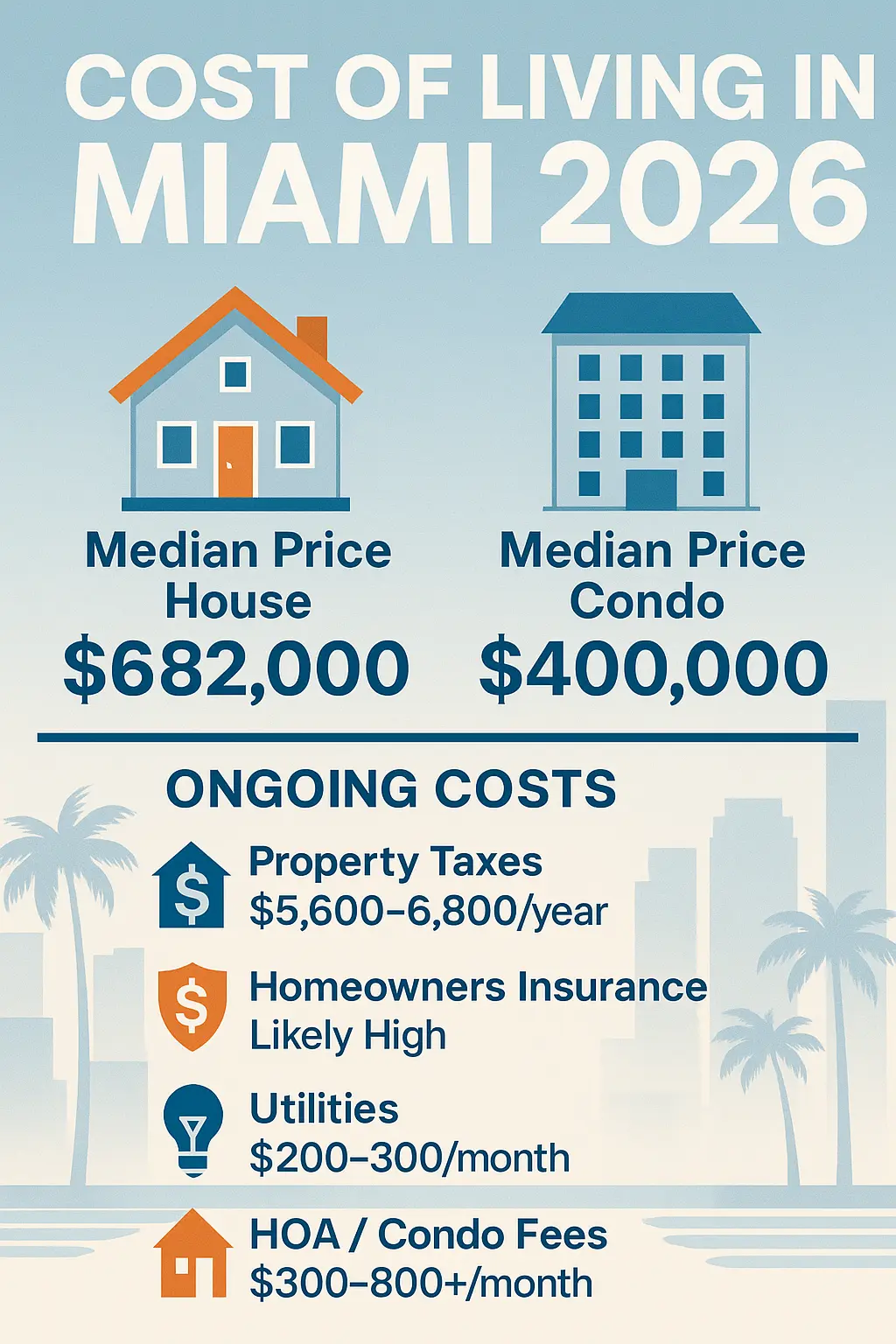
Cost of Living in Miami 2026 — What to Expect (Houses & Condos)
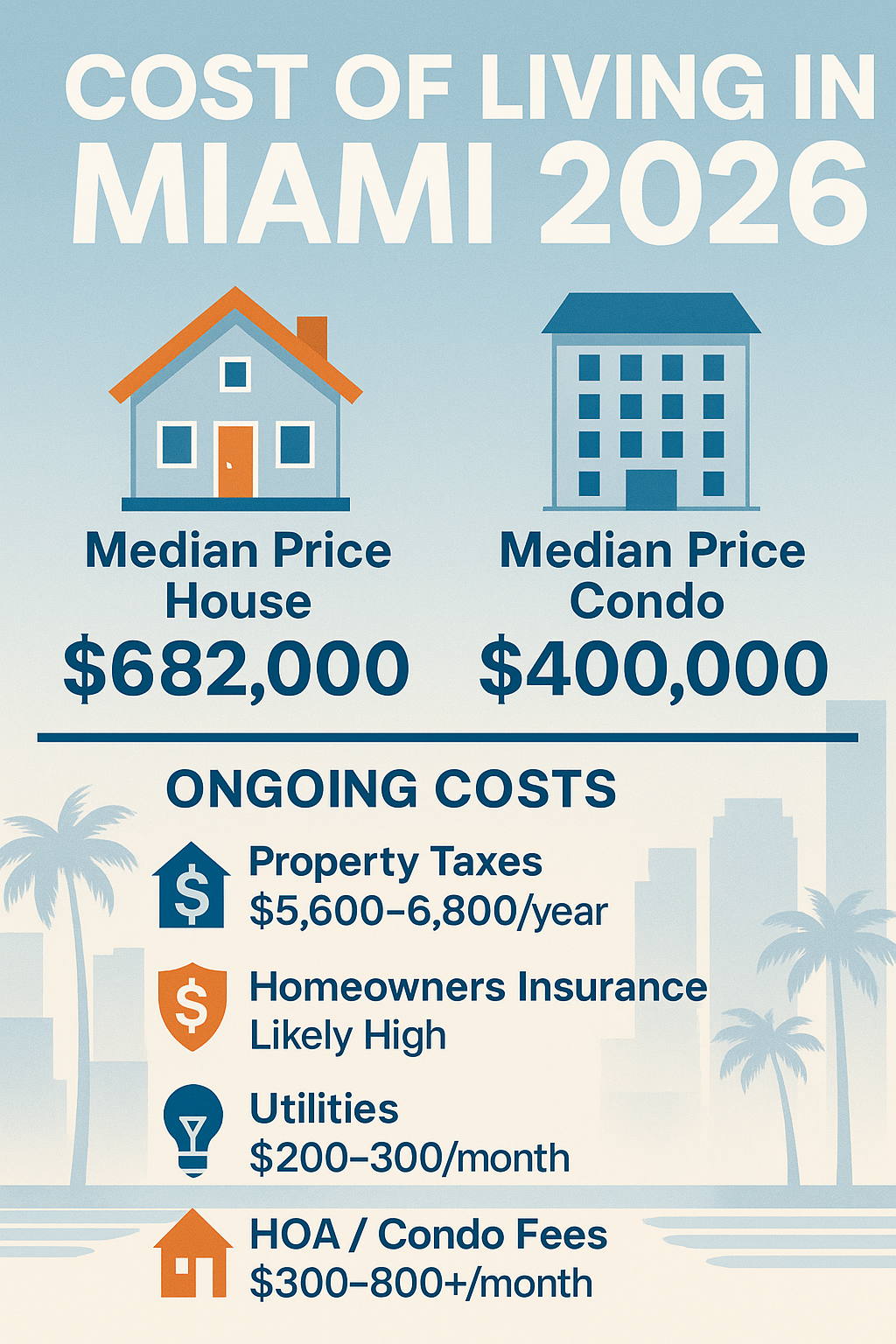
Explore the true cost of living in Miami in 2026 — from homeownership (house vs. condo) to taxes, insurance, utilities, and everyday expenses. Use real price examples to budget effectively if you plan to move or buy in Miami‑Dade County.
Introduction
Miami remains one of the most desirable places to live in the U.S., thanks to its vibrant culture, warm weather, beaches, and booming real estate market. But living in Miami also comes with a premium cost.
If you’re considering buying a home or condo — especially with median prices around $682,000 for a house or $400,000 for a condo — it’s crucial to understand all associated living expenses: mortgage, property taxes, insurance, utilities, groceries, transport, and more. This guide breaks down the realistic 2026 cost of living in Miami to help you plan wisely.
Housing Landscape & What “Median Price” Means in 2026
-
As of late 2025 heading into 2026, median home prices in Miami‑Dade reflect approximately $682,000 for a typical house and $400,000 for a median condo.
-
Housing is often the largest expense in Miami — overall cost of living in Miami is estimated to be about 21% higher than the national average.
-
Compared to state and national averages, housing costs (purchase or rent) in Miami are significantly higher — a major factor affecting overall living costs.
Annual & Monthly Expenses: Homeownership (House vs. Condo)
| Expense Type | Estimated Cost — House ($682,000) | Estimated Cost — Condo ($400,000) |
|---|---|---|
| Property Taxes | ~$5,600 – $6,800/year (≈ 0.82%–1.0% effective rate) | ~$3,300 – $4,000/year |
| Homeowners Insurance & Flood/Hurricane Risk Premiums | Likely high — premiums for a $300,000 dwelling at ~$5,400/year; higher-value homes will cost more. | Moderate — expect proportionally lower premium than for full‑size house |
| Mortgage (Principal + Interest) (assuming 20% down, 30‑yr loan, 6.5%–7% rate) | Approx. $3,800–$4,200/month before taxes/insurance | Approx. $2,200–$2,450/month before taxes/insurance |
| Utilities (electricity, water, etc.) | $200–$300/month | $150–$250/month |
| HOA / Condo Fees (if applicable) | N/A (for standalone homes), but budget for maintenance/repair | Could be substantial — varies widely: $300–$800+/month |
| Living Expenses (Food, Transport, Healthcare, Misc.) | Higher than U.S. average: groceries, services, and goods ~7–11% more expensive. | Similar — smaller households may reduce food/utilities costs |
⚠️ Note: The estimates for mortgage assume down payment, credit scores, loan terms. Insurance & HOA/condo fees vary significantly depending on location, building age, flood zone, and coverage levels.
What It Costs to Actually Live in Miami (Beyond Just Housing)
-
The overall cost of living in Miami is about 19–21% higher than national average.
-
Monthly expenses for a single person (excluding rent/mortgage) — groceries, utilities, transport, healthcare and other essentials — are estimated around $1,350/month.
-
For a family of four, living costs (excluding housing) can easily exceed $5,000/month depending on lifestyle and spending habits.
Renting vs Buying in 2026: Comparing Costs
If you decide to rent instead of buy:
-
As of early 2026, average rent for apartments in Miami remains high — the typical monthly rent across apartment types tends to be well above national averages.
-
For many renters, monthly rent + utilities + other living costs may approach or exceed what a modest mortgage payment might cost — though without building home equity.
Buying (house or condo) can be more cost‑efficient long‑term, especially if you stay for multiple years — but it requires upfront capital, stable income, and careful budgeting for recurring expenses (insurance, taxes, maintenance, utilities).
Why Miami Costs More — Key Factors
-
Housing demand & limited supply: High demand for housing — both domestic and international — drives home and condo prices up.
-
Insurance & natural‑disaster risk: Because of hurricane and flood risk in Miami‑Dade, homeowners insurance is more expensive than national average. State‑wide insurance market pressures have driven premiums higher in 2026.
-
Overall higher cost of goods/services: Everyday costs — groceries, utilities, services — tend to be higher than national norms (5–11% higher for various categories).
-
Climate-driven expenses: Air conditioning, flood insurance, storm-prep costs — these add up and increase recurring monthly and annual expenses more than in many other cities.
Who Can Afford Miami in 2026 — What Income You Need (Approximate)
Based on the housing and living‑cost estimates above:
-
For a house at $682,000 — to comfortably afford mortgage, taxes, insurance, maintenance, and living costs — a household income around $150,000–$180,000+ (before taxes) is likely required.
-
For a condo at $400,000 — a lower but still substantial home price — a household income around $90,000–$120,000+ could suffice, depending on debt load, down payment, and lifestyle.
-
Individuals or small families would need to budget carefully on groceries, utilities, insurance, and lifestyle to stay financially comfortable — or consider renting vs. buying.
Tips to Manage & Lower Your Cost of Living in Miami
-
Consider condos or smaller homes — reduces mortgage, insurance, maintenance, and utilities.
-
Shop for insurance & flood coverage carefully — compare providers to reduce premiums, especially in flood‑prone zones.
-
Use energy‑efficient appliances and strategies — given heat and humidity, A/C and cooling bills can be a major expense.
-
Budget realistically for taxes, insurance, and maintenance — they add up; don’t ignore them when planning your purchase.
-
Rent vs. buy depending on timeline & stability — if you expect to stay in Miami only a few years, renting might be more economical than buying.
Conclusion
Miami offers an alluring lifestyle — sun, sand, culture, and opportunity. But it also comes with a high cost of living, especially when you factor in housing, insurance, and day‑to‑day expenses.
With median home prices of $682,000 for houses and $400,000 for condos in 2026, it’s critical to budget carefully and consider all recurring costs before buying.
Whether you opt for a house or condo — or choose to rent — it pays to be financially informed: plan for taxes, insurance, maintenance, utilities, and living costs, and ensure your income aligns with your desired lifestyle.
Bottom line: Miami is not for everyone — but with the right budgeting and choices, homeownership or living in Miami can be achievable and rewarding.
Frequently Asked Questions (FAQ) — Cost of Living in Miami 2026
Q: Is Miami more expensive than other major Florida cities in 2026?
A: Yes. Miami consistently ranks as one of the most expensive cities in Florida, especially for housing and insurance costs. Cities like Tampa, Orlando, and Jacksonville tend to have lower median home prices and living costs.
Q: How much does a typical homeowner need to earn to afford a house in Miami in 2026?
A: For a median-priced house ($682,000), a household income of $150,000–$180,000+ is recommended to cover mortgage, taxes, insurance, and basic living expenses.
Q: Are there affordable neighborhoods in Miami for first-time buyers?
A: Yes. Areas like West Kendall, Homestead, and parts of North Miami may offer more budget-friendly options compared to Brickell, Coral Gables, or Coconut Grove.
Q: How much are average monthly utilities in Miami?
A: Utility costs vary by property size but typically range from $150 to $300/month, depending on air conditioning use and household size.
Q: What is the typical cost of condo fees in Miami?
A: Condo association fees vary but often range from $300 to $800+/month depending on the building amenities, age, and location.
Q: Is it cheaper to rent or buy in Miami in 2026?
A: It depends on your situation. Renting may be more affordable short term, but buying can be more cost-effective long term — if you plan to stay in Miami for several years.
Q: What drives high living costs in Miami?
A: High real estate demand, natural disaster insurance premiums, and increased prices on goods and services all contribute to Miami’s elevated cost of living.
Categories
Recent Posts










GET MORE INFORMATION
