
Cap Rate Explained for Beginners: A Simple Real Estate Guide
Cap Rate Explained for Beginners
Learn what cap rate means in real estate, how to calculate it, and why it matters for property investors. This beginner‑friendly guide explains cap rate with examples to help you make smarter investment decisions.
Introduction: What Is Cap Rate?
If you’re stepping into real estate investing — whether it’s your first property or your tenth — you’ve likely heard the term cap rate. But what exactly does it mean?
Cap rate, short for capitalization rate, is one of the most important metrics investors use to evaluate the potential return of an income‑producing property. In simple terms, cap rate helps investors estimate how much income a property could generate relative to its value.
This guide breaks down cap rate explained for beginners — what cap rate is, how to calculate it, why it matters, and how investors use it to compare properties and make informed decisions.
What Cap Rate Really Means
Cap rate represents the return on an investment property based on the income it produces, measured as a percentage. It helps you answer the question:
“If I bought this property today with all cash, how much income could it generate each year compared to what it’s worth?”
Unlike ROI or cash‑on‑cash return (which consider financing), cap rate focuses strictly on the income and value of the property.
How to Calculate Cap Rate
The formula for cap rate is:
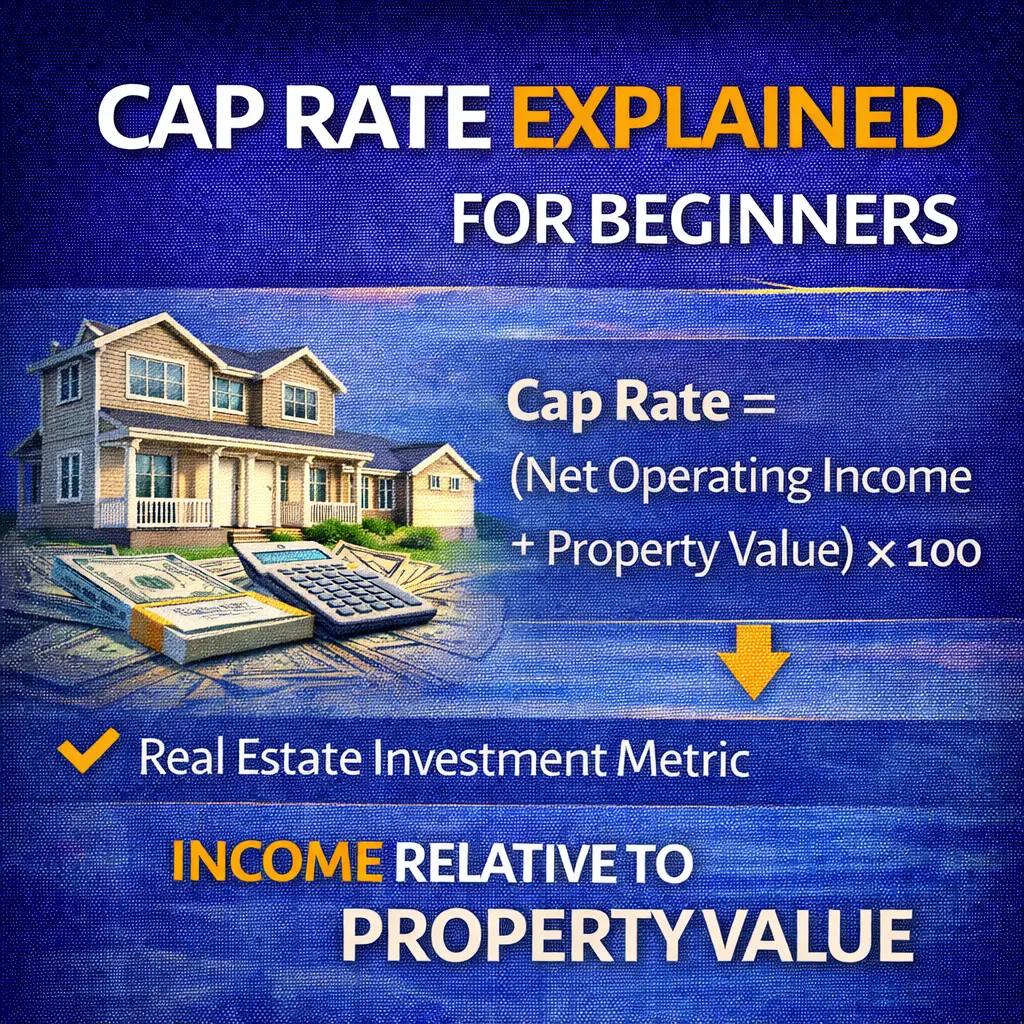
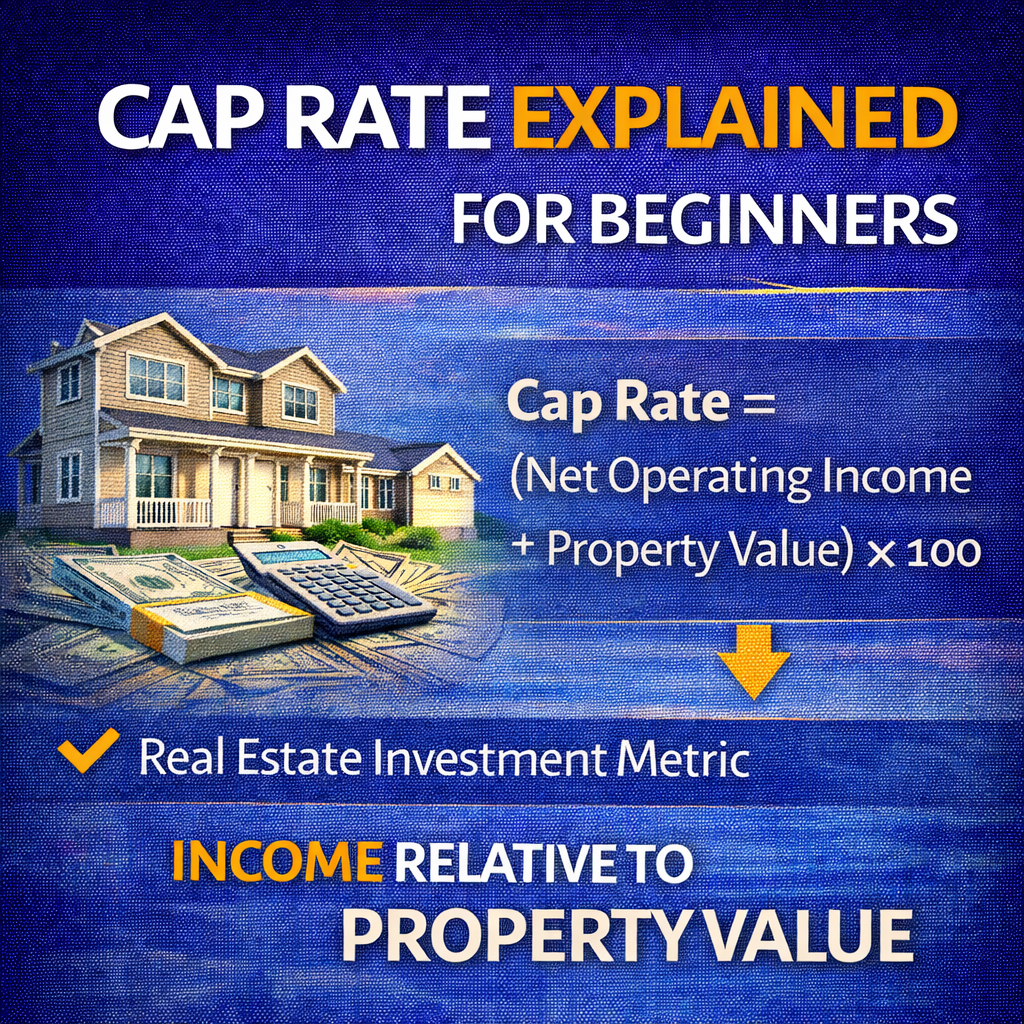
Cap Rate = (Net Operating Income ÷ Property Value) × 100
Here’s what each term means:
-
Net Operating Income (NOI) — Rental income after expenses, but before mortgage payments and taxes.
-
Property Value — The price you paid (or market value) of the property.
Example
If a property generates $50,000 annually in net operating income and its market value is $1,000,000, the cap rate is:
$50,000 ÷ $1,000,000 = 0.05, or 5%
This means the property returns 5% of its value in income each year — before financing or taxes.
Why Cap Rate Matters for Investors
Cap rate is useful because it:
1. Compares Investment Opportunities
Cap rate allows investors to compare different properties regardless of price or size. A property with a higher cap rate typically suggests a potentially higher return — but with important caveats (more on that below).
2. Reflects Market Conditions
Areas with higher demand and lower risk often have lower cap rates, while riskier or less desirable areas may have higher cap rates.
3. Helps Estimate Value
If you know a property’s NOI and typical market cap rate for similar properties, you can roughly estimate its value — a key skill for negotiating and analysis.
Cap Rate Versus Other Metrics
Cap rate is one tool in your investment toolbox, but it’s different from:
-
Cash‑on‑Cash Return — This considers mortgage financing and actual cash invested.
-
ROI (Return on Investment) — A broader metric that includes appreciation and tax benefits.
Cap rate focuses strictly on income relative to value — a clean way to compare properties without complications from financing.
What a ‘Good’ Cap Rate Looks Like
There’s no one “perfect” cap rate. What’s considered good depends on:
-
Location — Desirable markets often have lower cap rates.
-
Property Type — Multifamily, retail, office, and industrial assets may trend differently.
-
Risk Profile — Lower risk generally corresponds with lower cap rates, while higher risk properties may show higher cap rates.
Investors must balance cap rate with risk tolerance and market dynamics.
Cap Rate in Different Markets
In high‑growth urban markets, cap rates tend to be lower because property values are higher and demand is strong. In emerging or less competitive markets, cap rates may be higher — reflecting both higher return potential and higher perceived risk.
Understanding local trends helps investors choose properties that match their strategy — whether focused on steady income or higher yields.
Limitations of Cap Rate
Cap rate is insightful — but it doesn’t tell the whole story. It does not account for:
-
Financing (mortgage effects)
-
Appreciation or depreciation
-
Tax implications
-
Unexpected expenses or vacancies
For a complete investment analysis, cap rate should be used alongside cash‑on‑cash return, ROI, and market studies.
Conclusion: Cap Rate Explained Clearly
For beginners, understanding cap rate is a key step toward evaluating real estate investments confidently. It offers a clear picture of how income‑producing a property could be relative to its value — making it easier to compare options, evaluate markets, and make informed investment decisions.
While it doesn’t replace deeper financial analysis, cap rate gives you a strong foundation for evaluating income‑producing properties in Miami or anywhere you’re considering investing.
Frequently Asked Questions (FAQs)
What exactly is cap rate?
Cap rate is the ratio of a property’s net operating income to its value, expressed as a percentage — used to estimate income potential relative to price.
How do I calculate net operating income (NOI)?
NOI = Total rental income minus operating expenses like maintenance, insurance, management fees, and utilities (if owner‑paid).
Is a higher cap rate always better?
Not always. Higher cap rates can indicate higher returns, but also higher risk or less desirable locations.
Can cap rate change over time?
Yes. Cap rates shift with market demand, interest rates, and economic conditions.
Does cap rate include financing?
No. Cap rate is calculated before mortgage payments and does not consider financing structure.
Is cap rate useful for comparing properties?
Yes. Cap rate helps compare properties of different values by focusing on income potential relative to price.
Does inflation impact cap rates?
Inflation can influence interest rates and property demand, which may indirectly affect cap rates — as investors adjust expectations for returns in a changing economic environment.
Categories
Recent Posts










GET MORE INFORMATION
